In this article
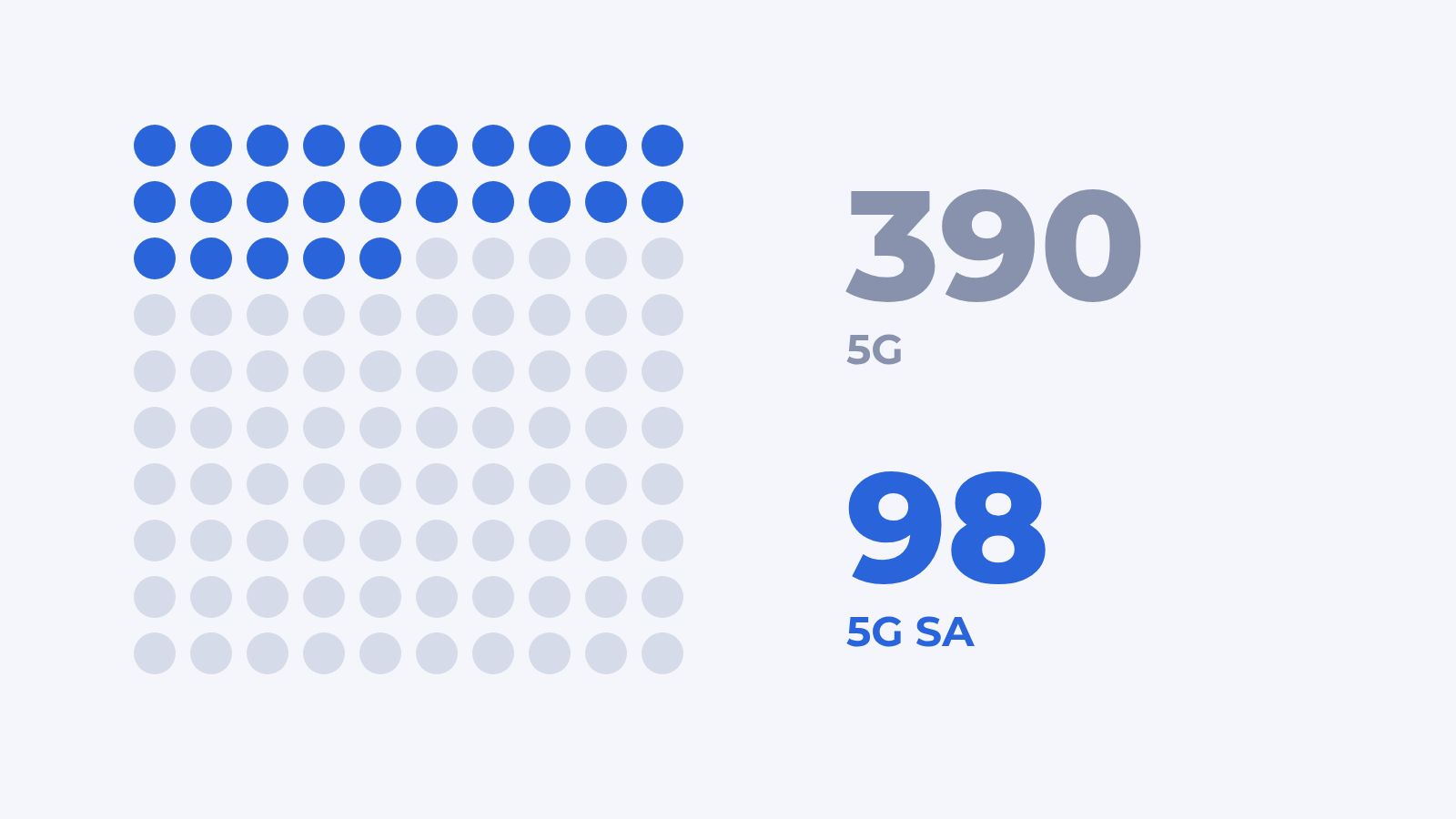
Light Reading summarized the GSA numbers on October 23, 2026: more than 390 operators have launched commercial 5G, and 98 of them have launched 5G Standalone. Seven years after the first 5G launches, 3 operators in 4 still run their 5G radio on a 4G core. GSA's explanation is short: moving from an EPC to a 5G Core costs money and brings a long tail of troubleshooting while subscribers migrate, and smaller markets feel it most. Everything that needs the new core waits in the same queue. RedCap has 17 launches as of September 2026, 4 of them this year. 5G fixed wireless has 276 launches against 453 for LTE FWA. SA roaming exists on paper and requires every pair of operators to set up and test the arrangement separately. Opensignal measured the same story in the US a week earlier: a year after nationwide SA deployments, AT&T users sit on an SA connection 4.4% of the time, Verizon 20.2%, T-Mobile 71.2%. The core is built. Turning it on is the part nobody wants to do untested.
What the numbers say
- 5G vs SA: 390+ operators with commercial 5G, 98 with SA. GSA's April 2026 snapshot counted 95 SA launches, so the pace is about 1 new SA network a month worldwide.
- RedCap: 17 operator launches by September 2026, gated by chipsets and modules, and by a business case to leave LTE and NB-IoT. No SA core, no RedCap.
- FWA: 276 operators on 5G FWA, Europe leads with 108. LTE FWA still has 453 launches. SA-based CPE price and rural SA coverage are named as brakes.
- 5G-Advanced: 19 launched, 41 investing, 5 testing. Also an SA-only feature.
- SA roaming: both home and visited network need SA, and each pair tests the N32 interconnect between their SEPPs individually. GSMA's NG.113 guideline for this runs 163 pages.
- US, Opensignal, October 2026: SA availability 71.2% (T-Mobile), 20.2% (Verizon), 4.4% (AT&T). AT&T's SA share grew under 5 points between April and June.
What this means for the business
The radio was the easy half of 5G. Antennas went up, the marketing went out, and the subscriber never noticed that the core underneath was the one from 2012. The core migration is where the operator's own money and reputation sit: a new AMF, SMF and UPF, a service-based architecture, slicing, and a subscriber base that has to move without a single visible outage. GSA says operators postpone it because of cost and troubleshooting. Troubleshooting is the polite word for finding out in production that the UPF drops sessions at 60% of the rated load or that the roaming partner's SEPP rejects half of your messages. Every month of delay also delays RedCap, FWA and 5G-Advanced revenue. The operators that launch SA on schedule are the ones that found those problems on a testbed, with emulated subscribers, before the first real one.
What this means for engineers
- Load the core, not the lab network. Core emulators (Keysight LoadCore, Landslide) emulate thousands of gNBs and millions of UEs with registration, PDU sessions and handovers. Measure AMF, SMF and UPF at the subscriber count and session rate of your busiest hour, plus 30%.
- Signaling storms: mass re-registration after a RAN outage, iRAT moves between 4G and SA, timers expiring at once. The data plane rarely kills a core launch. N1/N2 signaling does.
- UPF under real traffic mix: video, gaming, VoNR, with QoS flows and slices active. Throughput, latency and packet loss per slice, not one aggregate number.
- SA roaming pair by pair: N32 between SEPPs, PRINS or TLS, authentication and session setup with the actual partner's parameters. GSMA tells operators to test the APIs regularly. The first roamer should not be your test.
- RedCap and FWA devices against the SA core: reduced-capability UEs behave differently in registration and power saving. Test the real modules against the real core build before the launch date is public.
What to do
If SA is in your 2027 plan, write the core acceptance program now: subscriber load, signaling storms, per-slice QoS and at least one roaming pair, with pass thresholds in the contract with your core vendor. TEST4NET will help you turn that list into a test plan and run it with emulated subscribers before your customers become them. Test. Compare. Decide.
Sources
- Light Reading: 5G SA still a subset of 5G, hampering RedCap and more, GSA (October 23, 2026)
- GSA: 5G Standalone key data (April 2026)
- Opensignal: 5G Standalone in the United States, nationwide deployments but variable consumer availability (October 2026)
- GSMA NG.113 v14.0: 5GS Roaming Guidelines
- Keysight: LoadCore 5G Core testing (data sheet)

Written by
Alexander Zemskov
Alexander Zemskov leads network and security testing at TEST4NET, an independent, vendor-neutral testing lab in Yerevan, Armenia. With 19+ years in performance and load testing on IXIA, Spirent, Keysight, Xena and Xinertel platforms, he runs NGFW, WAF, IPS, DLP and SASE evaluations for telecom operators, banks and system integrators.