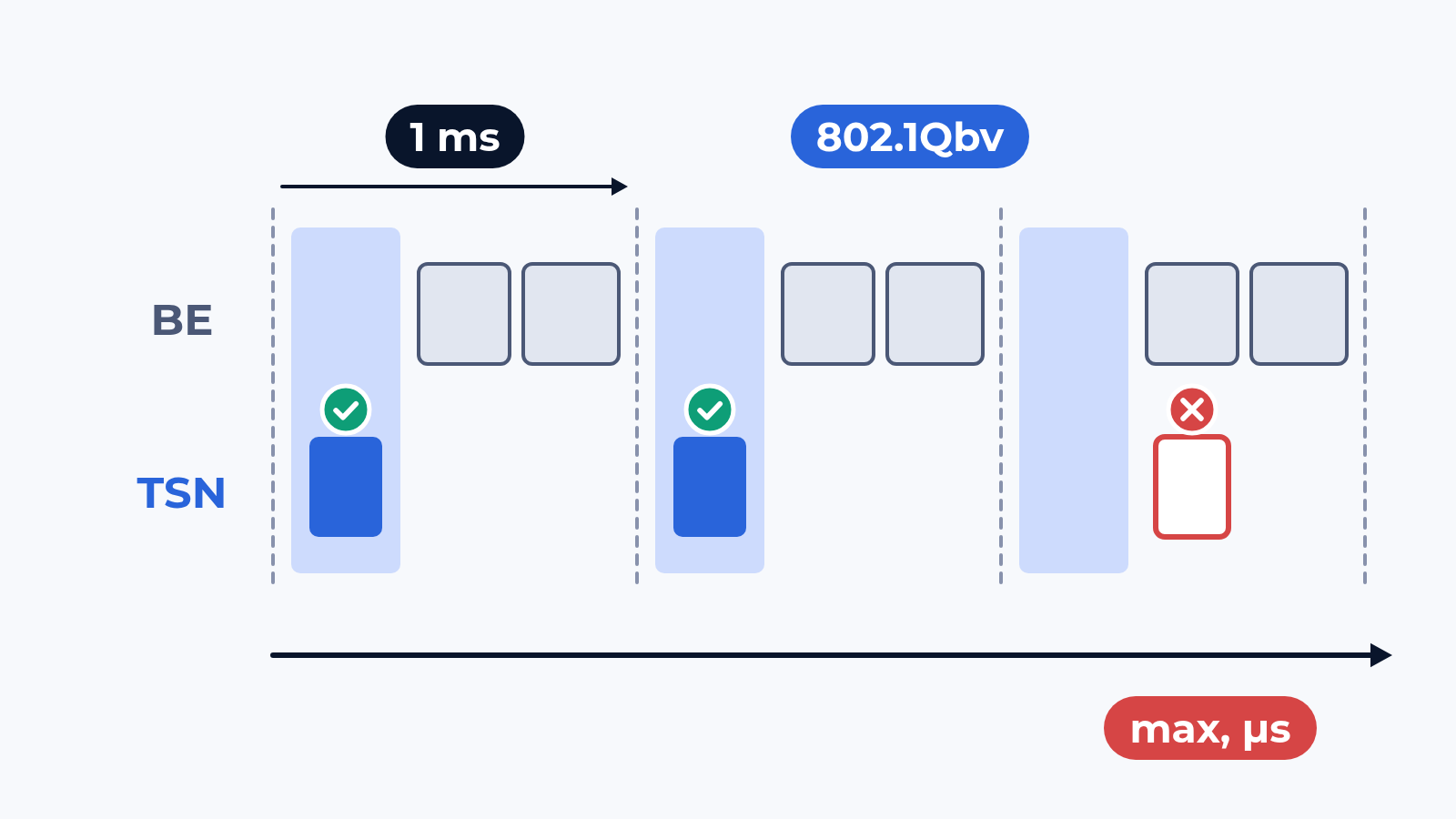
A switch for a factory floor or a fronthaul ring arrives with a TSN line in the datasheet: 802.1Qbv, 802.1Qbu, 802.1AS. That line lists firmware features. The controller on that network needs its control frame in every cycle, every 1 ms for example, within a fixed delay bound, while a camera stream and a firmware download share the port. An average says nothing here. TSN is judged by its slowest frame, so we time every critical frame and hold the highest value against the budget.
The bench
TSN cases are built per project. The device under test is a TSN switch or a chain of two or three (an example; your design sets the hop count) on 1G or 10G ports. The generator plays the end devices. The critical class is a periodic stream with its VLAN priority (PCP), a sequence number and a timestamp in every frame, sent at the cycle and offset of your schedule. Best-effort streams from other ports fill the same egress up to line rate. Both ends sit on one generator, so the latency of every frame is read against one clock.
The gate schedule works only while every hop agrees on the time. PTP is emulated on our generators, and we read the lock state from the switches under load. Time error in nanoseconds needs a dedicated timing analyser, which the bench does not have yet, so full timing analysis is agreed per project. PTP itself has its own post.
What we check
- Scheduled traffic (802.1Qbv): critical frames leave inside their gate window on every hop, on an idle port and with best effort at 100%
- Delay per frame: maximum, 99.999th percentile and jitter of the critical stream against the budget per hop and end to end
- Loss: zero lost or late critical frames over the whole run, counted by sequence number
- Frame preemption (802.1Qbu, 802.3br): the wait a long best-effort frame adds to an express frame, preemption on and off, and whether both link partners really enable it
- Guard band: the best-effort rate the port still delivers once the schedule takes its share
- Stream reservation: a stream that does not fit is refused, and admitted streams keep their timing
- Per-stream policing (802.1Qci): a talker above its reservation is cut off before it reaches the windows of other streams
- Soak: 8 hours at full load (an example), since a drifting schedule shows up only as rare late frames
Priority queues and shapers under TSN are covered in our QoS post. Pass criteria are written before the run: a maximum latency per hop, zero late frames.
What usually breaks
Preemption on one side only. The switch has it enabled, the link partner never confirms it, and the port silently falls back to waiting for the whole frame. A 1500-byte frame holds a 1G wire for about 12 µs. In a typical project the average latency of the critical class stays flat, while the maximum grows by exactly that amount on a small share of frames. A test that reports averages passes it.
Second: an offset between hops. Each switch opens its gate on time by its own clock, and their base times differ by a little more than the window. The critical frame reaches the second hop just after the gate closed and waits a full cycle. The histogram gets a second peak exactly one cycle to the right. On the bench it shows within minutes; on a production line it looks like an occasional controller timeout.
Third: marking at the edge. An end device sends untagged frames or the wrong PCP, the switch maps them into the critical class, and best effort starts using the protected window. Per-stream filtering catches this when it is configured, and often it is not.
What is in the report
Per stream and per hop: minimum, median, 99.999th percentile and maximum latency, jitter, lost and late frames, with the histogram. The same table with preemption on and off, and the best-effort rate left after the guard band. The lock state per switch and scenario, marked as a check with emulated PTP. Gate control lists, configuration, firmware and port plan, so the vendor can repeat any item. Fronthaul switches also go through the transport class of the 5G and mobile core page.
Where to start
Send us the switch models, the firmware and the TSN design: streams, cycle times, gate schedules and the latency budget per stream. We answer with a draft test plan: the items, the bench layout and the dates. The report is yours to keep and to show to the vendor. Write to us or look at what else the bench does.
 Alexander Zemskov
4 min read
 Alexander Zemskov
5 min read