Every access point datasheet carries a PHY rate: 5.4 Gbit/s, 11 Gbit/s, 46 Gbit/s for Wi-Fi 7. The number is the modulation table. What a client gets in a meeting room with 40 other clients, 2 walls and a neighbour's AP on the same channel is a different figure, and TR-398 exists to measure it the same way every time. We run that sheet, and the parts of it that the AP under test can actually do.
The bench
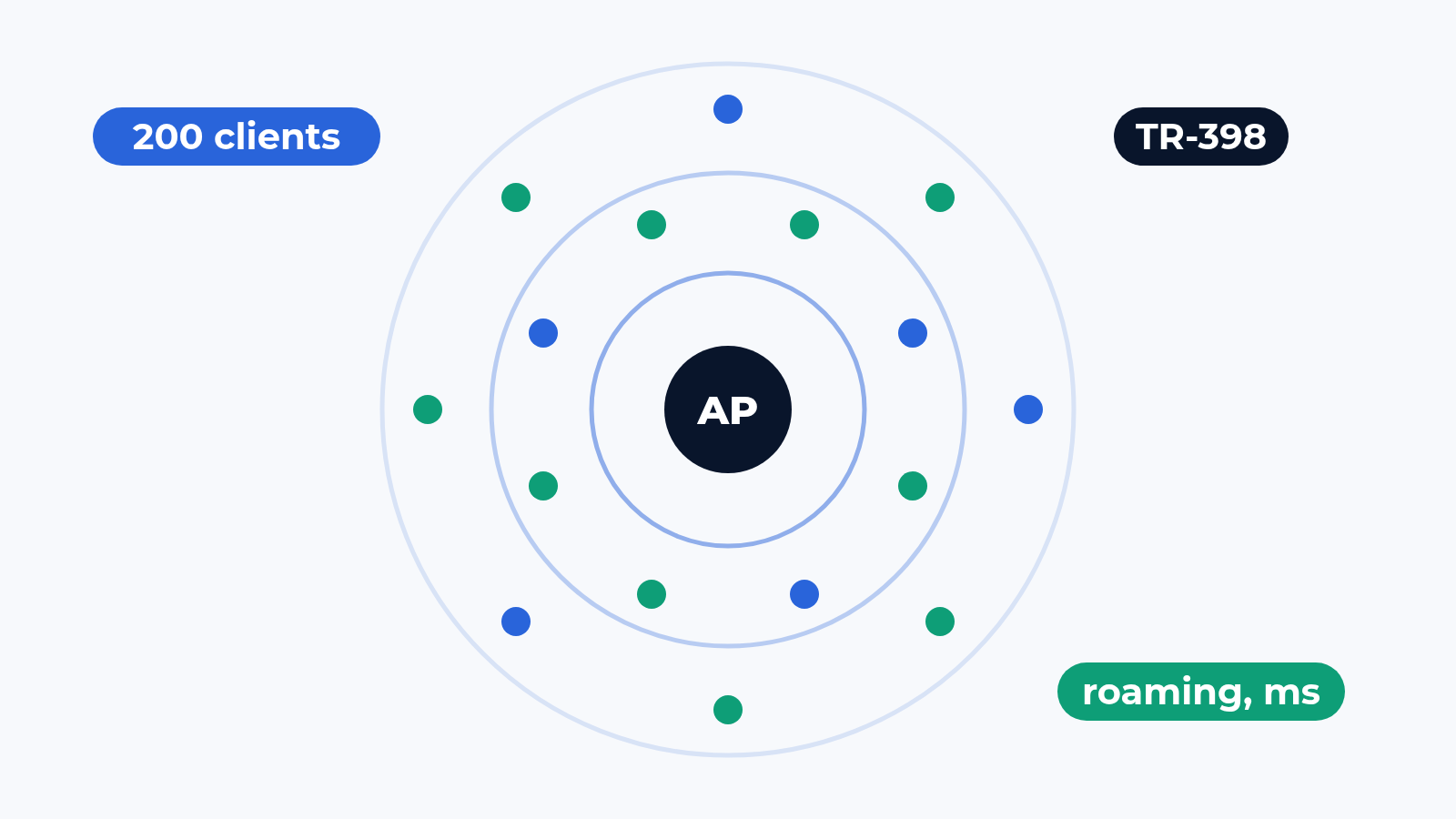
The access point under test sits in a shielded enclosure with the antennas cabled or in a controlled over-the-air setup. The generator emulates the clients: 10 to 200 Wi-Fi 6 stations today, with Wi-Fi 7 client emulation in progress, each with its own MAC, security association and traffic. Attenuators set the path loss, so a client at 30 dB and a client at 70 dB exist at the same time and the result does not depend on where somebody stood. The wired side of the AP goes to the same generator, so throughput is measured end to end.
The AP runs your controller profile, your SSIDs, your security and your band steering settings. An AP tested in default mode is a different product from the one you deploy.
What we check
- TR-398 items: receiver sensitivity, maximum connection, maximum throughput per band, airtime fairness, dual-band throughput, range versus rate, spatial consistency, multiple STAs performance, with the pass criteria of the standard
- Client scale: throughput per client and in total with 10, 50, 100 and 200 clients, association and authentication time for all of them at once
- OFDMA and MU-MIMO: whether the AP actually schedules multiple users, measured as the latency and throughput of small-packet clients when the big ones are busy
- Wi-Fi 7: multi-link operation, 320 MHz channels and 4K QAM where the AP and the emulation support them, with the measured gain over Wi-Fi 6 on the same traffic
- Roaming: a client moves between 2 or 3 APs with 802.11r, k and v, the gap in milliseconds per roam, with voice traffic running
- Security: WPA3 and WPA2 mixed, 802.1X with the RADIUS exchange timed, PMF, the authentication rate with 200 clients joining at once
- Interference: a co-channel neighbour and a non-Wi-Fi source on the bench, and the throughput that remains
- Soak: 24 hours with 100 clients running an application mix, memory and client count compared with hour 1
What usually breaks
Client count. The datasheet says 512 clients per radio. At 120 emulated clients with traffic the AP starts dropping associations, and the vendor confirms the 512 was measured with idle clients. Your auditorium needs the number with traffic.
Second: roaming. The 802.11r gap is 40 ms on the demo and 900 ms on the bench, because the production profile has 802.1X with a RADIUS server 30 ms away and no PMK caching. The profile, not the radio, decides the call quality in the corridor.
Third: airtime fairness. One client at 70 dB path loss with a legacy data rate takes 60% of the airtime and 40 good clients share the rest. TR-398 has an item for exactly this, and the AP either passes it or it does not.
What is in the report
The TR-398 sheet with the measured value and the standard's threshold per item. Throughput per client count as a curve. The roaming table with the gap per roam and per method. OFDMA results as latency for small clients under load. Interference results. The AP configuration, the client emulation settings, the attenuation plan and the firmware, so the vendor can repeat any item.
Where to start
Send us the device model, the firmware you plan to run and the topology it will sit in. We answer with a test plan: the items, the bench layout and the dates. The plan is free, the report is yours to keep and to show to the vendor. Write to us or look at what else the bench does.
 Alexander Zemskov
4 min read
 Alexander Zemskov
4 min read