







Wi-Fi Testing for High-Performance Use Cases: Why a Walk Test Is Not a Test
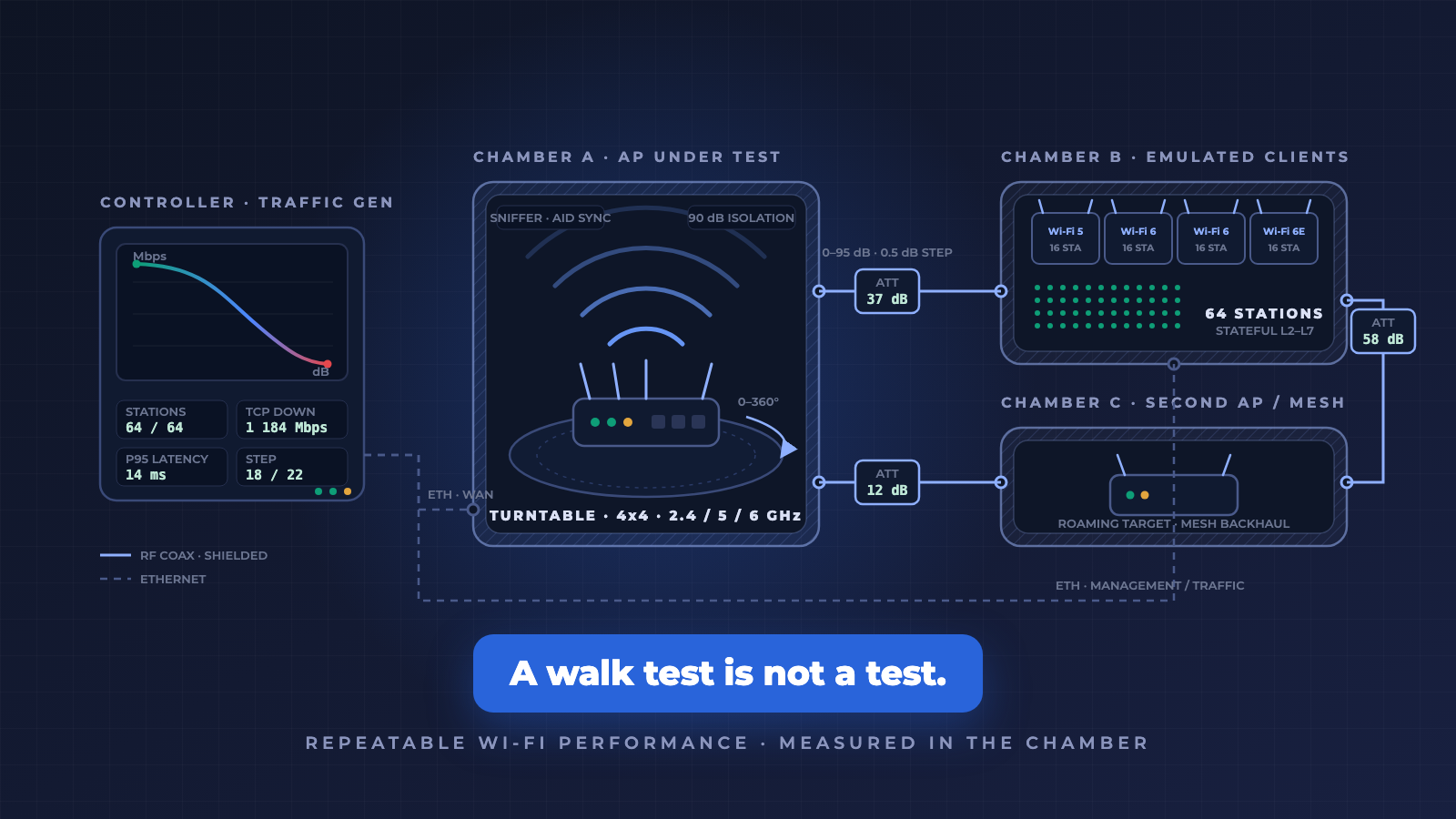
Wi-Fi used to be the network you tolerated. Now it carries the video call with the customer, the telehealth session, the factory floor and the classroom. This post is abo…

Independent network & security testing lab
An independent lab for network and security testing. We integrate the tools, put your systems under real load and real attacks, and hand you measured results — real insights, not assumptions.
Ecosystem partners


The test, network and security vendors we work with: tools we run in our own CloudLAB, integrate into customer environments and support — so recommendations come from daily hands-on use, not a price list.
How you connect
Test entirely inside our cloud, or keep the system under test on your own site — either way you get the same automation and reporting.
Open a browser and connect straight over the internet — the rig lives in our Armenia lab. Nothing to install, nothing to VPN into.
Only a virtual load module runs on your hardware, driving traffic into your physical or virtual system. Control, automation and reporting come down a site-to-site VPN from our cloud.
What's in the lab
Line-rate traffic from 1G up to 100G ports, across every protocol your stack actually runs.
DDoS and security strikes plus AppMix application traffic, run under production-like conditions.
Easy deployment and agent-based mesh testing across any cloud, hybrid or on-prem environment.
NGFW, TLS and L7 testing at up to 100G, on purpose-built lab hardware we maintain and calibrate.
Realistic traffic · AppMix
Modern firewalls, DPI engines and application-aware routers behave differently for every protocol and application. Replaying an old capture or running legacy packet-blasting tests gives numbers that look precise and mean nothing for your network.
A capture is stateless and stale: no live TLS handshakes, no application logic, no sessions the device actually has to track.
Raw-packet throughput says little about a box that inspects, decrypts and classifies every flow. The results come out inflated or simply wrong.
We capture a traffic profile on your network or pull it from your NMS / APM systems, then turn it into an AppMix: the share of each protocol and application in the aggregate load the test generates.
How we work with you
Analysing system requirements and building optimised testing strategies that reduce risk during development, procurement and operations.
Independent validation of new hardware and software against technical requirements before deployment — lower rollout risk, faster time to market.
Custom automated testing architectures that cut operational overhead and deliver faster, repeatable results.
Structured scenarios covering real-world use cases and edge conditions, catching issues before they become costly fixes.
Choosing the right hardware, software and virtual tools for your actual workload — accurate results without overprovisioning.
Hands-on training so your own engineers can run precise, extensive performance and functionality tests.
Where it delivers value
How we validate
Two checks against the spec. Standard test methodologies: RFC 2544 and RFC 2889 for switching and routing, RFC 9411 (the successor to RFC 3511) for firewalls and other security devices, ITU-T Y.1564 for Ethernet services, Broadband Forum TR-398 for Wi-Fi access points. And protocol conformance: does the BGP, OSPF, IPv6 or IPsec implementation follow its RFC state by state and message by message, including the malformed and out-of-order cases a demo never sends. The baseline before any performance number is worth trusting.
Walks every configuration path — normal operation, edge cases and the failover in between: security policy and NAT rules, IPsec and SSL VPN tunnels, HA switchover, OSPF and BGP convergence, QoS marking and queuing, IPv4/IPv6 dual-stack, logging and management APIs — to confirm each feature behaves the way the spec says it should, not just the way the demo did.
Ramps load past the vendor's stated limit — throughput, concurrent sessions, new connections and TLS handshakes per second — using an AppMix built from your real traffic profile, not a flat packet stream. A box rated at 100 Gbps of raw packets can fold at a fraction of that under a realistic HTTPS, video and VoIP mix with attacks in the background. We find where it actually degrades and how gracefully: the number that matters when real traffic spikes.
Popular use cases
Make procurement decisions based on real performance metrics.
Provide data-driven arguments for IT and security investments.
Compare, verify and optimise setups before deployment.
Maximise the efficiency and performance you already paid for.
Make sure an update won't disrupt your network before you install it.
Validate and integrate innovations with confidence.
Maintain high standards through rigorous validation.
Showcase real-world benefits with measurable results.
Identify and resolve issues efficiently.
Prepare personnel through hands-on lab testing.
From the blog
Wi-Fi used to be the network you tolerated. Now it carries the video call with the customer, the telehealth session, the factory floor and the classroom. This post is abo…
Alexander Zemskov
·
·
15 min read
This is the sixth post in a series on evaluating network security products. Part 1: the datasheet gap. Part 2: NGFW traps. Part 3: WAF, IPS, DLP. Part 4: SASE. Part 5: me…
Alexander Zemskov
·
·
10 min read
This is the final part of a six-part series on evaluating network security products. Part 1: the datasheet gap. Part 2: NGFW traps. Part 3: WAF, IPS, DLP. Part 4: SASE. T…
Alexander Zemskov
·
·
8 min read
Send us the shortlist and the KPIs that decide it — we'll come back with a test plan, a timeline and a fixed price.